

Coming to the end of my photographic studies at the Rocky Mountain College of Art and Design, I am on track to graduate early on December 17th. With school coming to an end, I had the opportunity to showcase my passions and technical ability in a final thesis project to be displayed in my college’s annual graduation exhibition. This article will discuss the detailed process of my final thesis project, from its conception, execution, editing process, and final installation results. This article will focus on my photographic process and what I have learned from the experience including topics such as, failure, intentional prop use, camera settings, color, and use of post production to heighten one's photographic practice.
In previous projects, I have found enjoyment in the editorial portrait process of human emotion, more specifically, the obscure sorrows we feel in reaction to our contemporary world. Prior to this project, I was inspired by my favorite novel, The Dictionary of Obscure Sorrows (2021), by John Koenig. With the words of this book consistently storming my mind, I felt urged to continue this project. While visualizing possibilities of this project and considering past use of this idea, I came to the conclusion that to steer my final project in a different but related direction. Without understanding the direction I hoped this project would go, I sat on the thought for several days before I had to submit my project proposal. Falling from rabbit hole to rabbit hole in research, I understood my reliance on technology and social media to conceive this project. While inspiration typically comes when you least expect it, I decided to base my senior thesis on such a concept. I turned in my project proposal, stating that I would create a photographic series aimed at creating a discussion on our society's reliance on technology for things such as entertainment and even work. There is always much to learn in the conception of a project, as it is the very basis of the work that represents me as a person and a photographer. Casting a broad net within my previous idea of obscure sorrows, I felt there was more value to be taken from it, and in the end, I felt no need to throw away an idea that had not yet served its purpose to its fullest extent. With this idea set in stone and the necessary preparations in place, it was time for me to execute the concept.
This project was pitched by the end of the first week of the term and had to be printed and installed, with related materials, by week six. With four weeks to create this series, I had to begin shooting, no matter how prepared I was. I made plans to fashion one image per week, with each session restricted to four hours. Taking advantage of the benefits my school has offered, I scheduled our campus studio space and called on a friend and classmate to model for me in my first concept, society's reliance on security cameras and depicting the anxious emotional reaction of being constantly surveyed. With no elaborate visual in mind, I felt a struggle to connect with my model and give proper posing instructions. After all, I was trying to materialize a narrative I had not yet visualized myself, and hoping my model’s instincts would paint the picture for me. I continued shooting for the duration of my scheduled time before the concept reached its limit. Taking the raw files home to edit, I struggled to edit the image in a way that would compensate for what the image lacked. Regardless, this project was important, and I had come up with something.
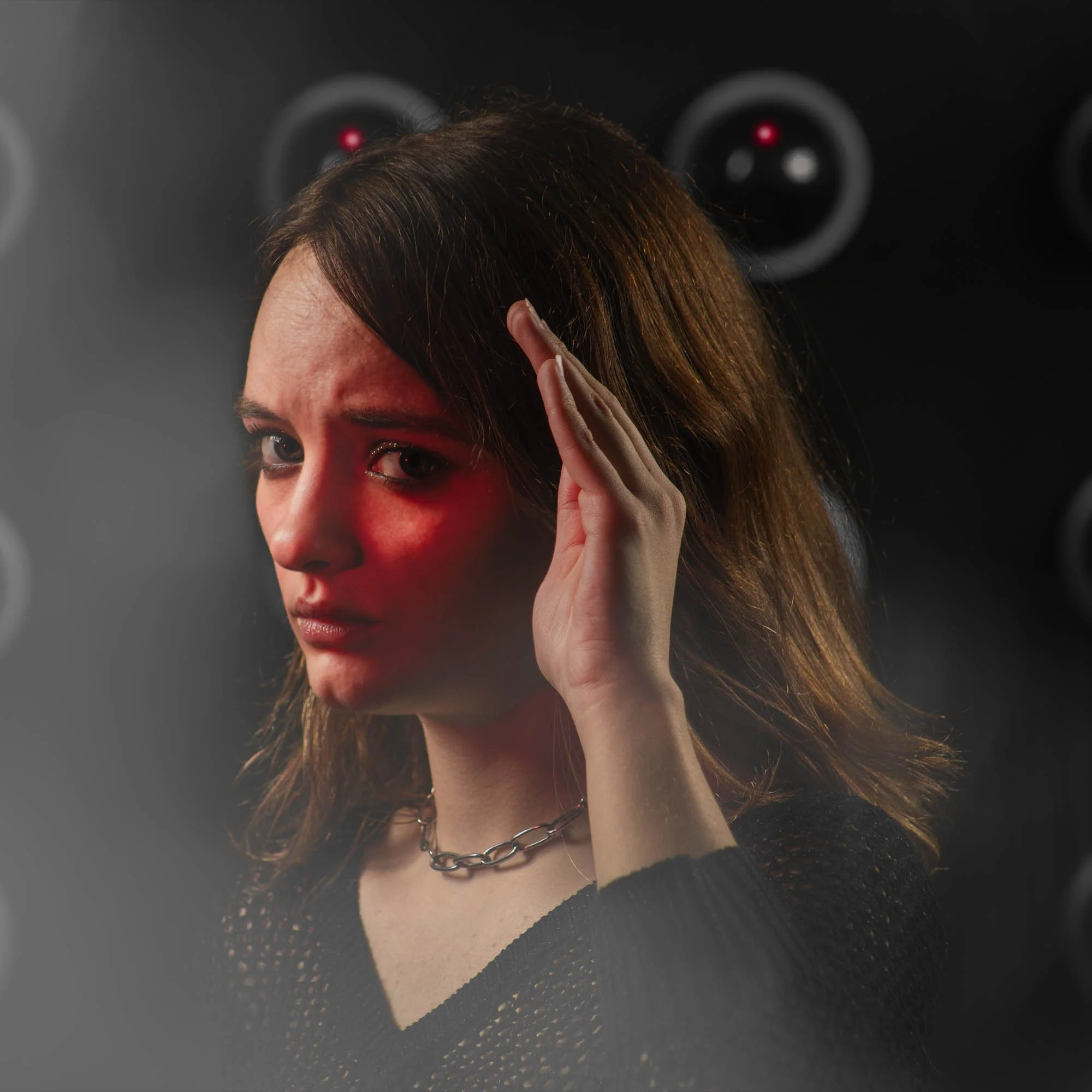
Realizing that this image was not everything I hoped for, there were many things I learned about this shoot in terms of how to reshoot as well as changes to be made in my general practice. The relationship between the subject and model makes up nearly 50 percent of the image. Considering the image focuses on emotional reaction, one's ability to direct, visually articulate, and connect with the model personally can make or break an image. The remaining 50 percent that makes up my photography can be attributed to the cumulative thought into wardrobe, makeup, prop use, lighting, and editing.
When the image is finished, it is important to visually analyze and critique the work in order to determine if your current strategy is sufficient or if a change in direction is needed. The visual analysis of this image made me realize a few different things wrong with my current direction. My use of props are not organized in a manner that expresses my idea of mass security cameras, nor do they visually fit within the composition to be distinguished as security cameras to begin with. My use of color editing does not amplify or sufficiently add to the feeling I am attempting to convey. Lastly, I debated whether I would continue this series based on the relationship and availability of models. Due to my perfectionism and desire to control every element within my compositions, I decided the route of self-portraiture would be most beneficial to my newly conceived direction. This would allow me to tailor my narrative to my personal experience with technology reliance. I would also be moving in a direction where my images' emotions would not rely on the expression of the subject but rather on the use of props, body language, and color.
Three weeks remaining, I needed to pick up the pace and decided to execute two technological concepts in one photoshoot. I had a better visual idea of what I hoped to achieve, and with no rush to accommodate a model’s schedule, I was able to take my time and ensure I left with something I was excited about. This shoot focused on visualizing how I, and others, heavily rely on video games and cellphones for entertainment. I decided to convey these ideas by obscuring my identity with a controller and a cellphone. I began creating a variety in colors, wardrobes, and lighting, leaving with two final images that I was excited to edit and saw potential in. When completing my intensive editing process of cleaning up the images, correcting exposure, retouching skin, burning and dodging, and adding fragmented light filters from my archive, I felt pleased with the visual appeal of the final images.
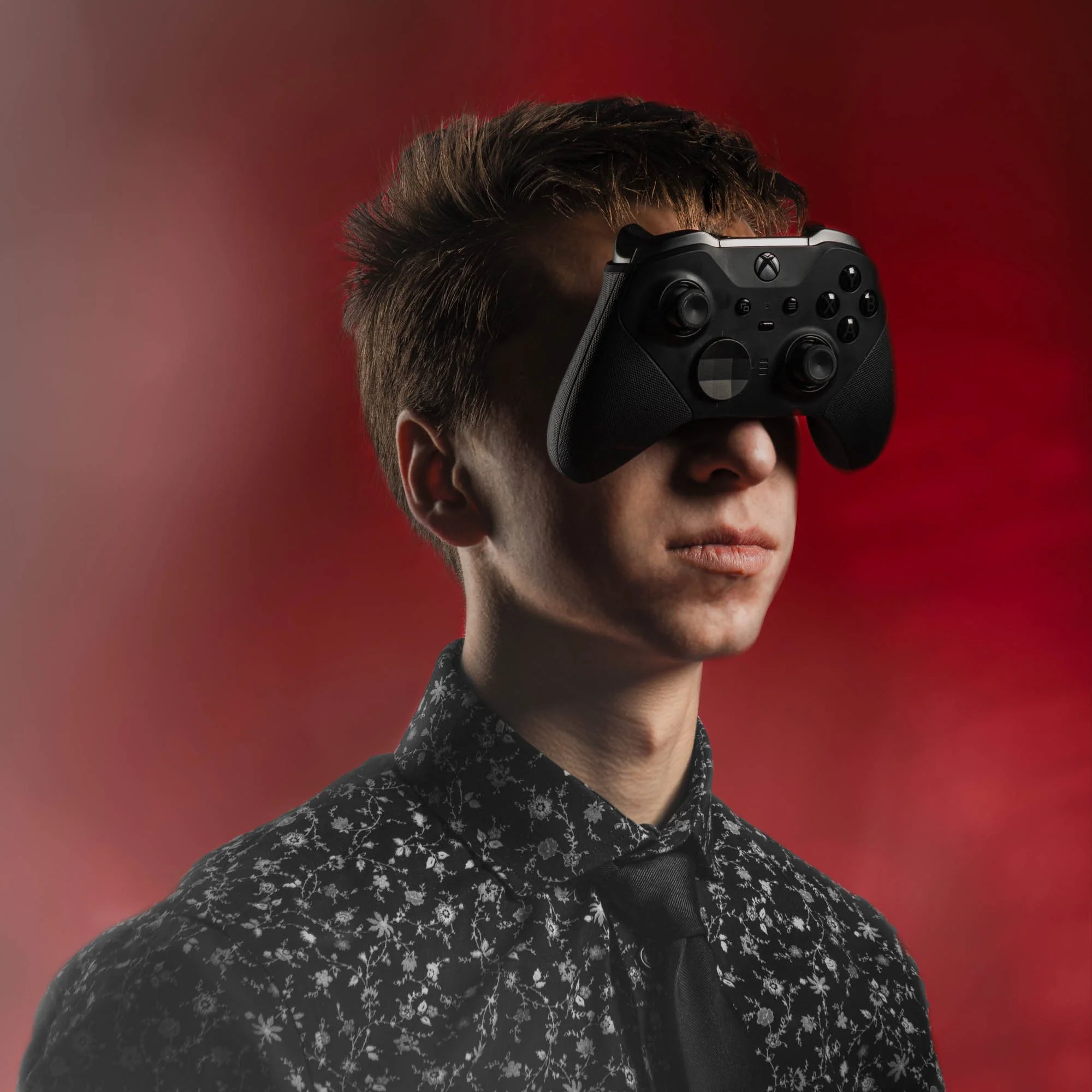
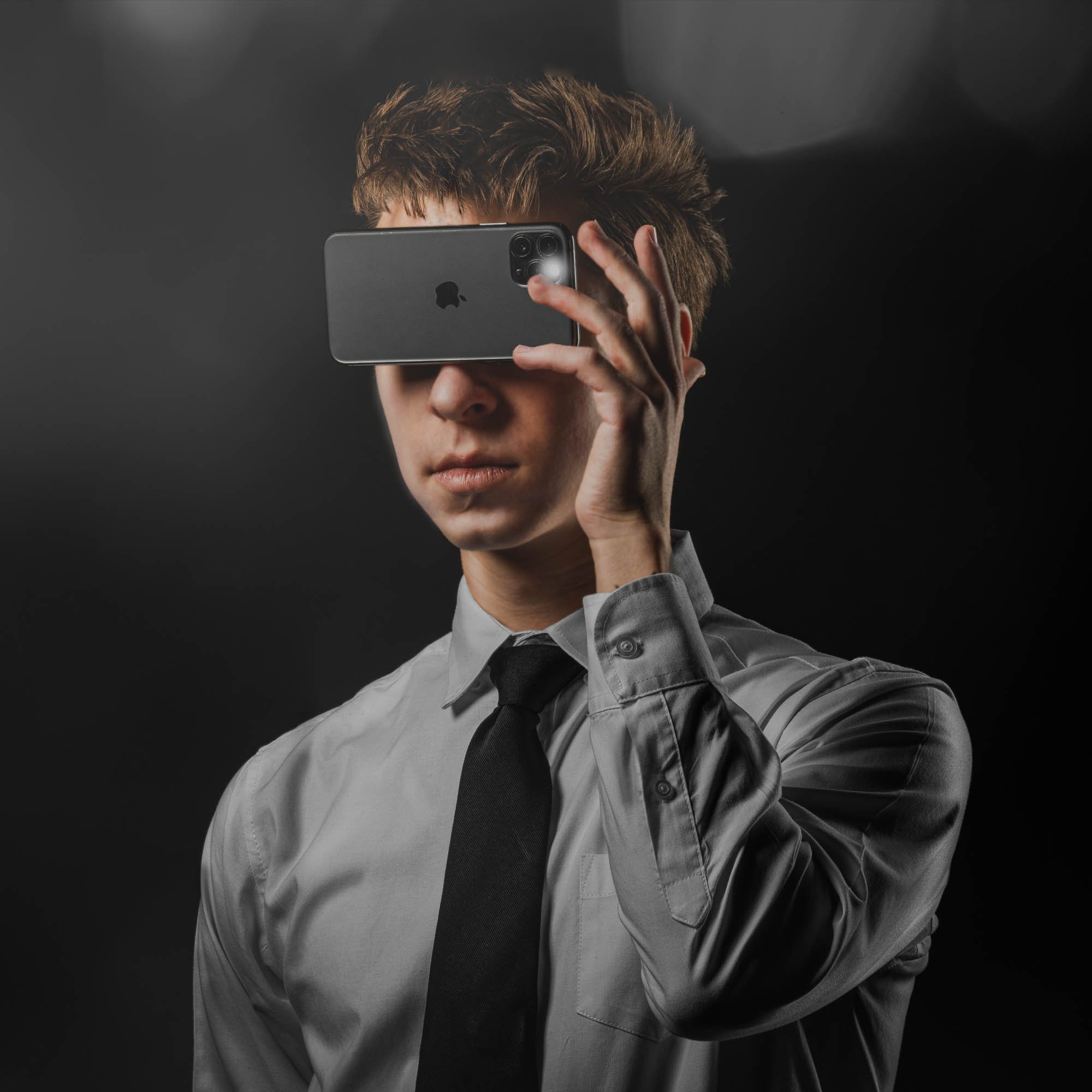
When analyzing my work, I realized the visual appeal was not compensating for the lack of emotion and unclear narrative in this image. Although objectively adequate, the image's subjective appeal was missing something. The use of body language and props was too subtle and minimal. When trying to convey a visually reliant struggle with technology, I knew additional props and expressive body language attributing to my intended narrative were necessary. This experience showed me that although an image is visually appealing and created objectively well, in terms of lighting and editing, the emotional and subjective appeal is heavily reliant on the body language, color, and use of props in a photograph. With this said, I was not yet satisfied with the direction I was heading. In order to accommodate the lack of emotion and clear narrative, I concluded that additional corresponding props were needed, and body language to complement my intended theme was needed.
Two weeks before I needed to begin my exhibition installation preparations, I began preparing for my next photoshoot by buying designated props to illustrate a struggling relationship with my reliance on technology. With visuals in mind, I recruited my older brother to assist me in my efforts. An assistant proved extremely helpful, as my use of props required me to cover my face in bandages. This photoshoot attempted to redeem myself from my previously unsuccessful use of the video game controller, but with my previous experiences in mind and my brother behind the shutter, I was able to reach an image that checked off all of my previous mistakes.
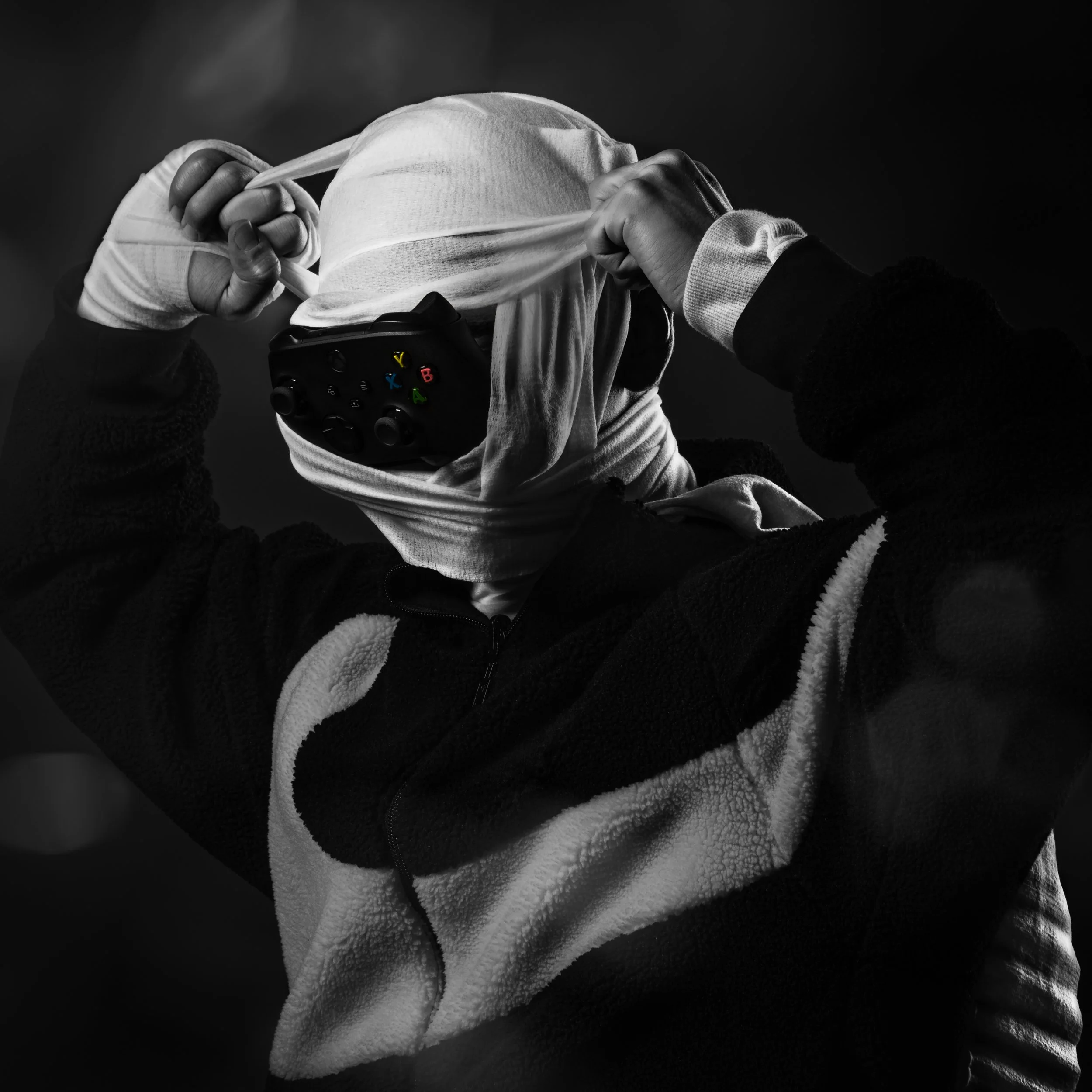
In my mind, this image easily surpassed that of my previous attempts. My wardrobe was reconsidered, from a professional shirt and tie to a casual fleece jacket. This was effective in giving more context to the environment in which video games are typically played, in one's home covered in comfortable apparel. My use of bandages to suspend the controller allowed me to illustrate the idea of a medical addiction and provide context for the seriousness of such reliance. My use of body language displays an attempt to rip off the bandages, indicating a desire to be released and freed from the obscurely tethered controller. Lastly, the use of selective color, highlighting the controller’s buttons, puts emphasis on the controller and its interaction with the black and white subject, furthering the intended narrative and theme of the image. Besides correcting the negative aspects of my previous attempt at this concept, my reiteration proved objectively successful in terms of composition, dramatic lighting, and post-production workflow. My biggest takeaway from this shoot pertains to the idea of failure. Although obvious and cliche, Without my previous failure of this concept and my attempts to understand and build off of what hadn’t worked in the past, I would not have arrived at a final image sufficient to my objective. The initial objective of this project was to conceive and execute each concept with ease, but it took falling down to understand how to get back up.
With one week remaining, nerves set in, and the realization that I had only succeeded in photographing a single image that met my standards dawned on me. I made plans to photograph two previously attempted concepts, namely the cell phone and the security cameras. Going into this photoshoot alone, I had made several preparations to ensure I could make up for my previously failed attempts.
Feeling well prepared, I began setting up equipment, where I constructed a three- to four-point lighting scenario, allowing me to properly light my face, back, props, and backdrop. This also allowed me to easily manipulate the set-up when moving to different concepts. My photographic process while shooting self-portraits is typically very concise and slow-moving. Starting by adjusting my camera settings to my desired reciprocity, I then turn one strobe light on at a time to ensure its power output is achieving my desired effect and exposure. I repeat this with all the lights included in the concept and begin dressing and setting up props in the composition and on my person. While making adjustments where necessary, I begin the actual photoshoot, where I set my camera's timer and begin the marathon of running back and forth to click the shutter and get into position. I begin experimenting with different body language that complements my previous theme, ripping away from the reliance on technology. With an iPhone charging cord wrapped tightly around my neck, I went with a pose that felt most natural in that situation, prying and pulling the cords wrapped around my person.
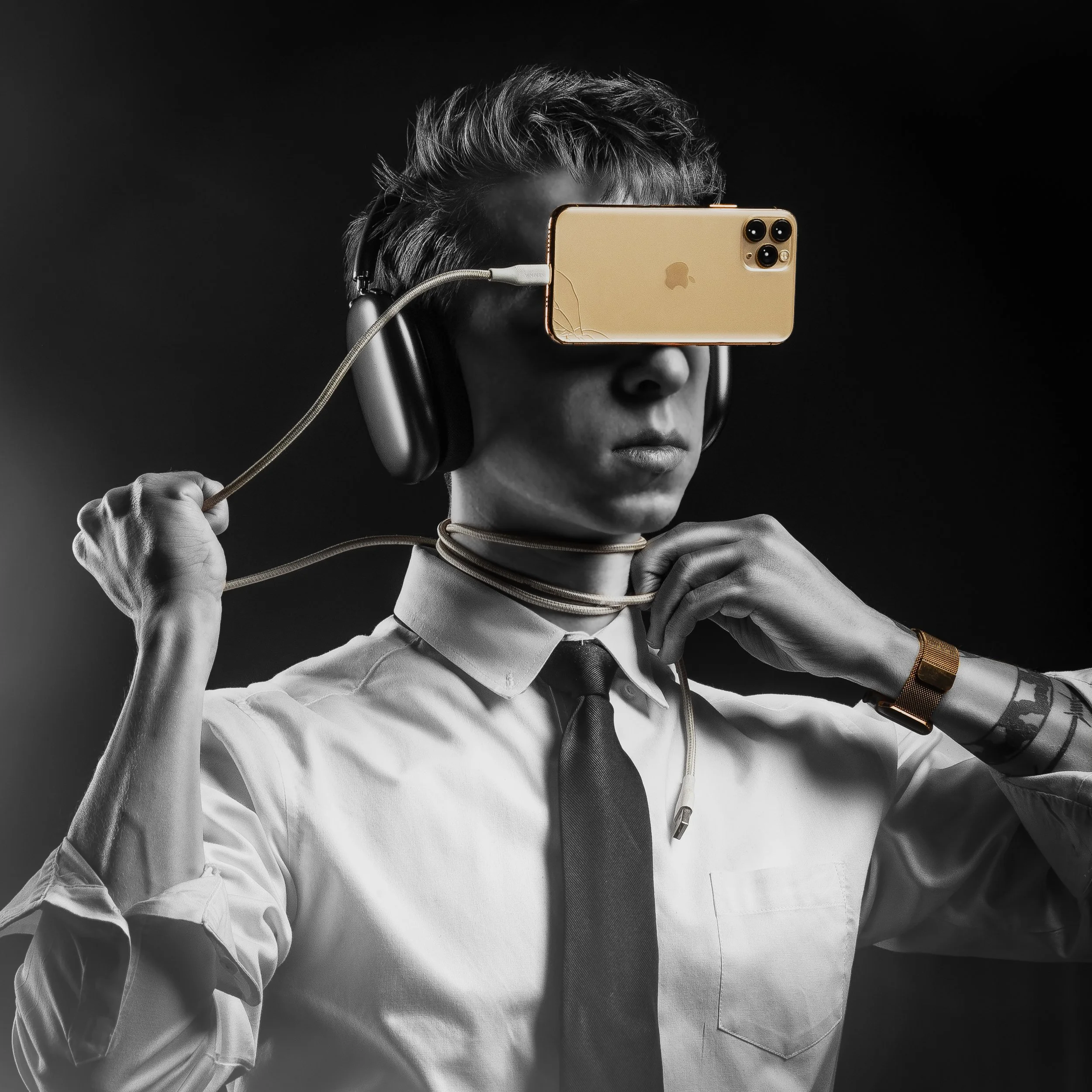
The end result comes as shown, and my visual analysis proved it successful. Through a more elaborate use of suffocating props, expressionless reactions, and struggling body language, I was able to depict a feeling of numb struggle. The combined effect allows me to express the idea that we are often numbed by the senseless scrolling and addiction to our iPhones and related devices, leaving us empty with an insufficient effort to escape its grip on our lives. The post-production efforts of this image allowed me to enhance this idea. The contrast in selective color between the subject and the technology surrounding me points to the idea that the technology is, again, in control. The use of dodging in this image allowed me to create a shiny finish on my skin, giving the impression that I am robot-like or no longer human. Overall, the accumulative aspects of this photograph proved far more successful than their counterparts, and I certainly felt excited to include this in my final project. There are many things I learned in the process between the first attempt and the final image. The biggest difference is the obvious use of more props. Instead of throwing a cellphone in front of my face and relying on body language as the voice of the image, I not only added correlating props to the main theme, but I was able to utilize them in a way to further express my theme. Although throwing all of these props may have proved successful in directing my theme, placing the props in a more deliberate position allows one to put the subject within a scenario that tells a more refined narrative. The use of props can always be manipulated in order to tell similar or completely different stories, and this project has certainly put an emphasis on their effectiveness.
The next half of the photoshoot was dedicated to creating a discussion on the feeling of being watched by the mass number of security cameras filling our urban landscapes. To create this feeling, I dressed in casual clothing such as a hoodie and a hat, with the purpose of concealing my face with the brim of the hat. My use of props contained 12 realistic dummy security cameras that encircled me on the backdrop behind me. Displaying the security cameras on the backdrop and posing in a way that hid my identity from the cameras may have been enough to portray my theme, so I decided to experiment with a few different ideas. It included the use of a red gel snoot light. This allowed me to shine a narrow red spotlight onto my face that replicated that of the security cameras' live footage indication. After experimenting with this for a while, I decided to add another element, which was shutter drag. The shutter drag allowed me to create a distorted and hazy silhouette around my person, creating a feeling of personal anxiety. These elements allowed me to create a combined effect, delivering a narrative about the anxiety one feels from constantly being watched and being overly conscious of their surroundings.
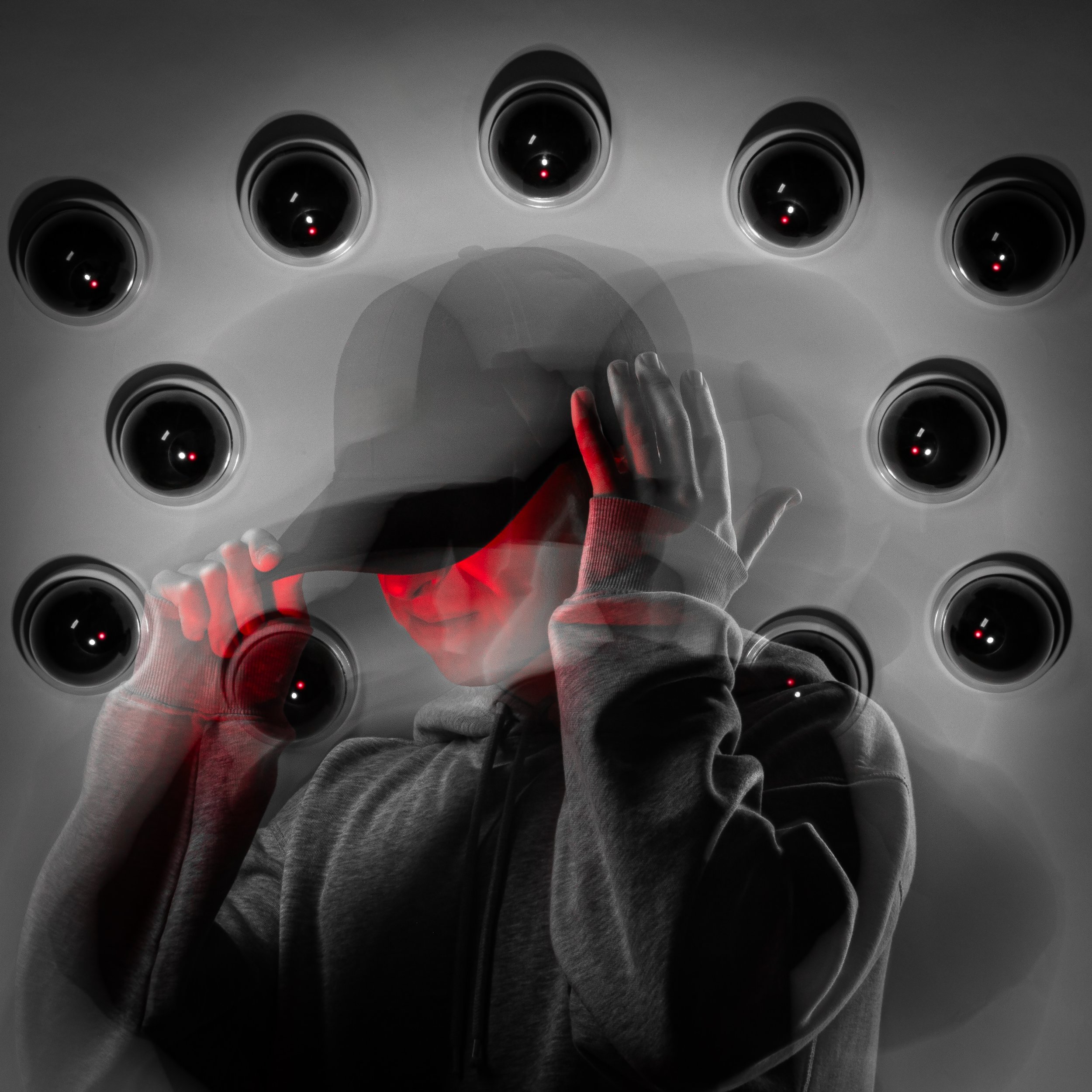
The post-production workflow allowed me to enhance this image by cleaning up any distraction, selectively containing the color red, and enhancing or adding additional lights to the security cameras. This showed me the simple but effective use of post-production editing to further the objective of this image. The biggest takeaway from this concept pertained to the idea of experimenting with multiple elements. To illustrate this further, my initial concept had only required the combined elements of my wardrobe, body language, expression, and the security cameras, but when finalizing the image with only these elements, I felt that it was missing something and that it needed more atmosphere and a sense of internal reaction to the cameras. This prompted me to pull what worked from my initial attempt and add the red gel to my strobe light. After experimenting with this, I felt it added more to the theme, but I wanted to see how much further I could push the concept. Adding in slow shutter movement filled the negative space nicely and added a piece of dynamic movement that suited my theme. I continued to add a couple more elements while I still had time to spare, but they began subtracting from the value of my theme, so I eventually removed them and stuck back to what worked. I think the beauty of this process can be seen in the experimentation. As a photographer, I have always felt it was necessary to push and push the theme until you started overcompensating. This allows you to get the most out of your concept and helps you understand what works and what doesn’t. The overall visual appeal and use of technical proficiency proved this image sufficient to my standard, and with only one week until the series needed to be finalized, I had one more idea to materialize.
My last concept to finalize the series included creating a narrative on the idea that we cannot remove ourselves from technology, even in our place of work. Considering this project focuses on my interpretation of the matter, I wanted to capture myself with a camera. I continued to stay on the path of obscuring my identity with the camera and wrapped my wrists with the straps of a typical, professional camera. This concept, although simple, proved more effective in its context to me than in its deliberate use of various photographic elements. As a photographer, I will always be beside this camera no matter what, and moreover, I rely on this camera to continue my way of life. By obscuring my face with the camera, it becomes a part of me. The straps enveloping my hands and wrists symbolize the idea that I don’t want to be apart from the camera. The use of retaining the red color of the camera straps puts emphasis on the relationship between me and the camera and puts the camera in a place above me, as I rely on the camera.
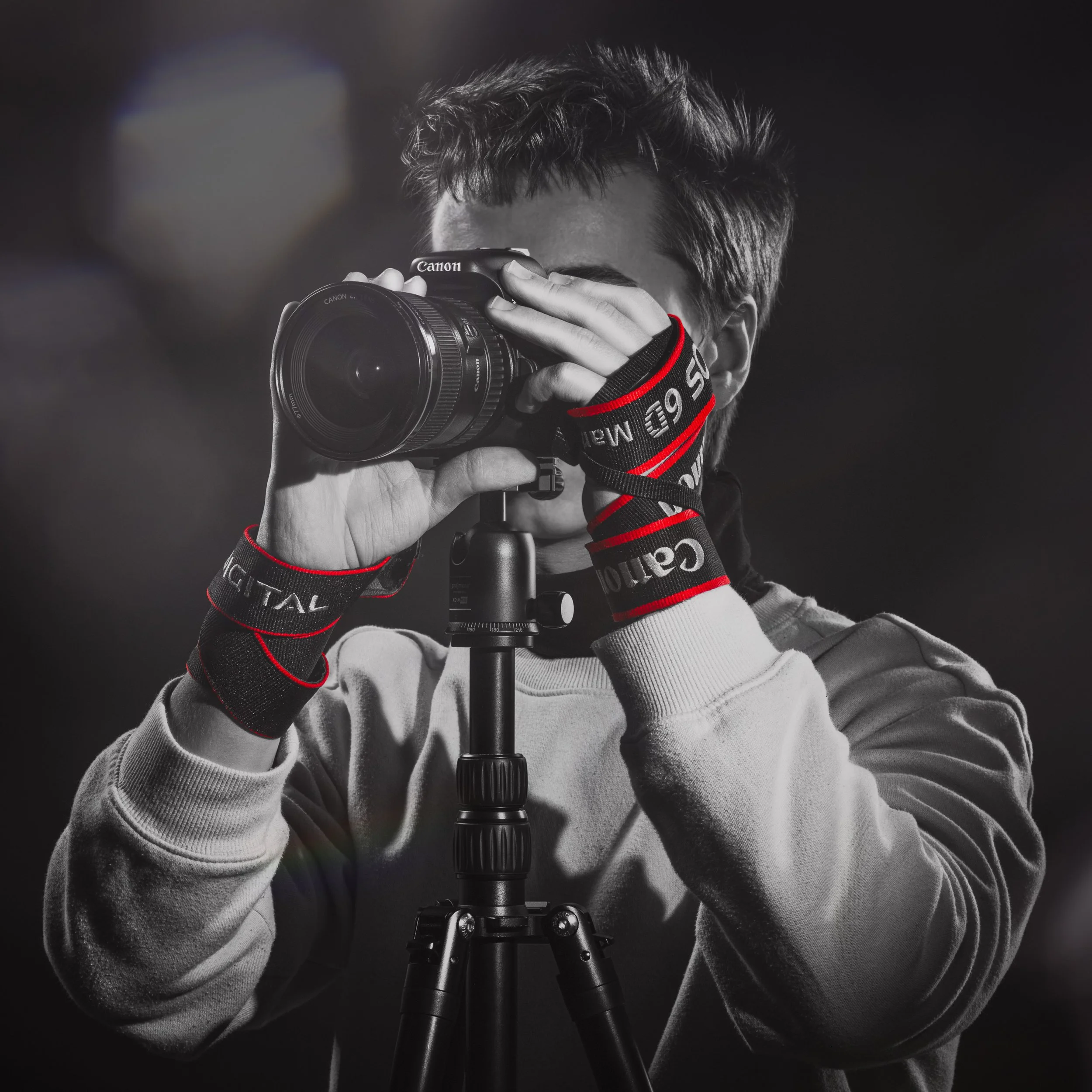
My final week to photograph was coming to a close, and not only did this image need to succeed, but I was extremely pleased with the visual effects that made up the image. Most notably, my use of filters. Although it sounds cliche to use filters in professional photography, I believe my visual aesthetic has expanded in terms of value. Many of the filters I have created are subtle, containing fragments or streaks of light, and help amplify the sense of environment within my work. These kinds of camera filters can be created extremely easily. Various photographed objects can be used to depict various environments, such as clouds, to give the effect of smoke or steam. One can also use glass or other transparent material and a flashlight to create a slow shutter image of the light fragmentations. This is the case with the image above. By adding the fragmented light beside the lens of the camera pictured, it creates visual variety and appears to add an effect interpreted as lens flare. These filters are extremely easy to construct and very valuable when it comes to greeting environments in a studio setting.
The execution phase of this project had finally come to a close, and I began to see the light at the end of the tunnel. My next phase required me to print, matte, frame, and create a cohesive installation at my campus’ gallery. I had no real concept to create a cohesive exhibition installation, but as time passed and the roots of the project crossed my mind, I decided to add more context to the conception of the photographic series. To do this, I displayed a wood letter titled “Obscure Sorrows,” added my artist’s statement and business cards, and included audience interaction by displaying the book that inspired the series, The Dictionary of Obscure Sorrows, by John Koenig. My first gallery installation was concise and simplistic, but it allowed for the possibility of interaction. Overall, the installation was something I could be proud of, and the reception was an amazing experience.
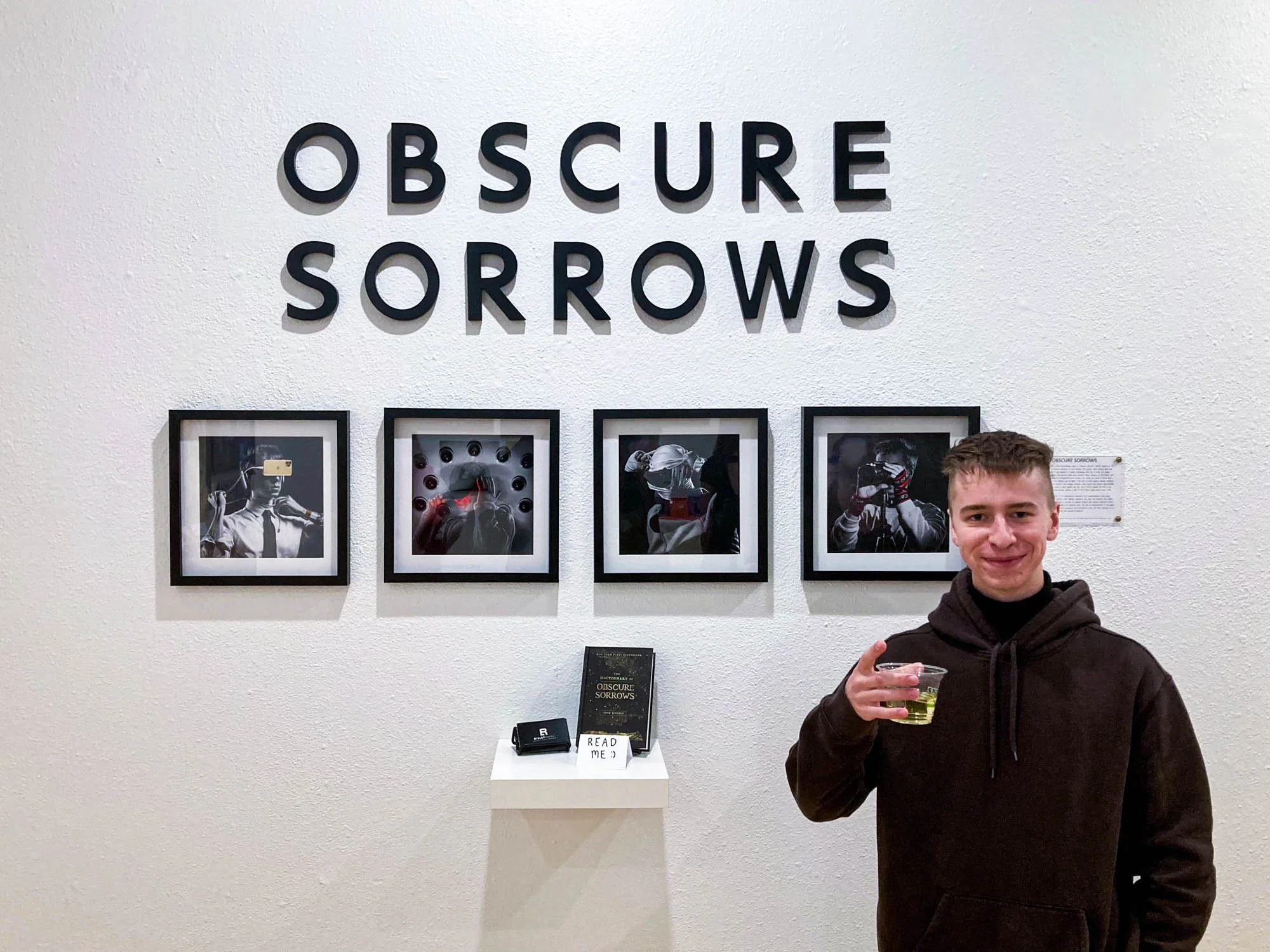
This project provided me with extensive experience, from concept development, post-production editing, to my overall photographic practice. This project taught me that the number of failures in this project was the key contributor to my ability to give it another shot and create something truly personal and appealing. I understood the greater use of props to not only express my theme but express an idea within a theme. Through deliberate placement of props, it is important to create a scenario with props that gives the image an expressed feeling. Building and experimenting with various elements, such as lighting, props, camera settings, colors, and more, allows me to bring a concept to its highest potential. Lastly, I can highlight the beautiful abilities of post-production. While using selective coloring, burning, and dodging, as well as the use of external lens filters, I can heighten the impact and environment of my concepts and prop use to generate an objectively proficient series of photographs. This process has allowed me to analyze and identify many things within my work that anyone can take into consideration for their next project. With various elements at play, I have created a final thesis project that marks the start of my own career in my photographic practice. There is always much more to learn and experience within such a detailed practice, and I hope to share these ideas with all of you.